Urine Glucose Levels Chart: How to Understand Sugar in Urine Without Panic
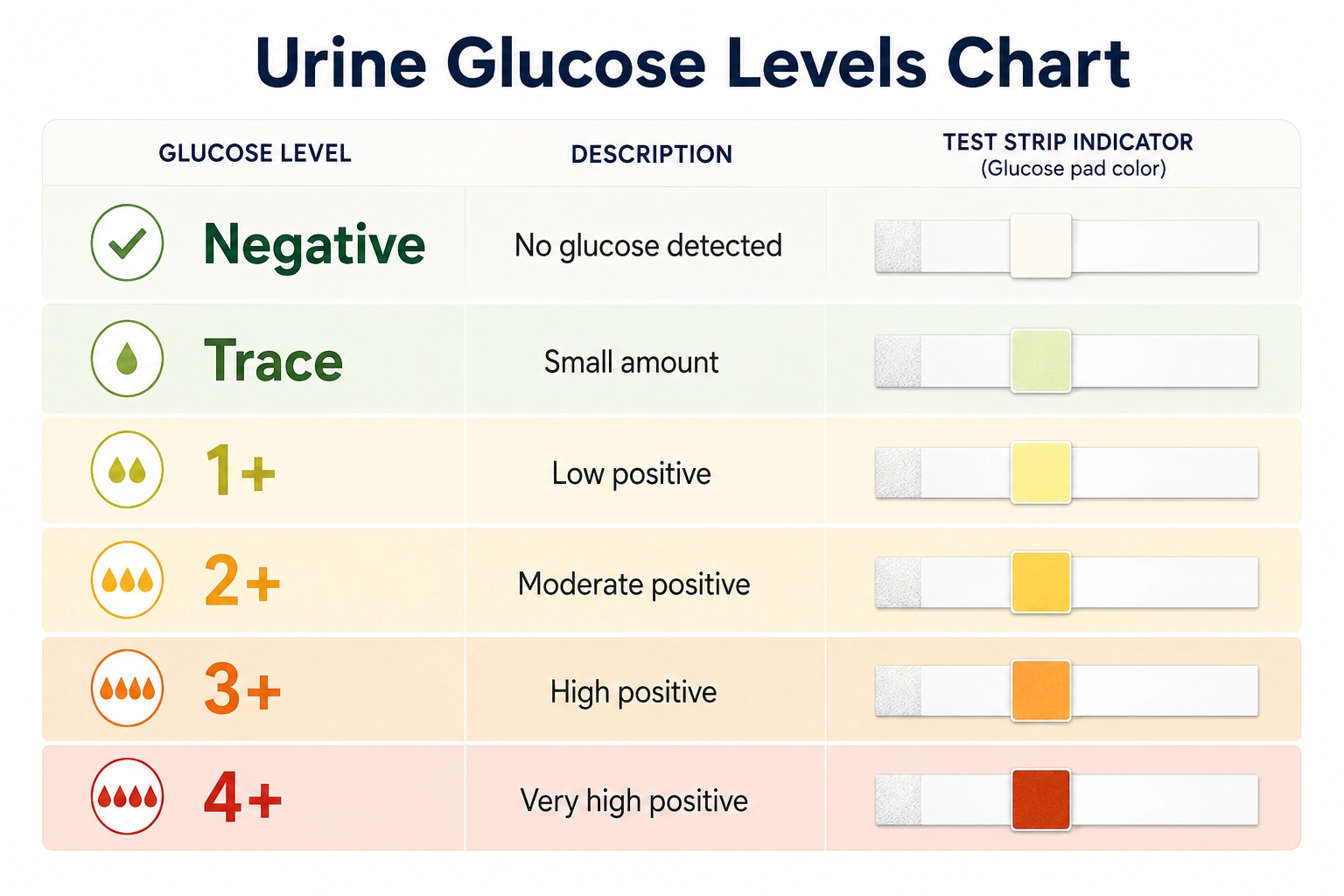
Table of Contents
- What Is Urine Glucose?
- Urine Glucose Levels Chart
- Why Urine Glucose Is Not the Same as Blood Glucose
- What Can Cause Glucose in Urine?
- How to Read a Urine Glucose Test Strip in Real Life
- A Practical Framework: Result + Repeat + Context + Symptoms + Confirmation
- Real-Life Example: The Routine Lab Report
- Real-Life Example: The Home Test Strip After a Meal
- Real-Life Example: Someone With Known Diabetes
- What to Track Alongside Urine Glucose
- Urine Glucose vs Blood Sugar vs A1C
- Common Mistakes When Using a Urine Glucose Chart
- Mistake 1: Treating urine glucose as a diabetes diagnosis
- Mistake 2: Thinking negative urine glucose means blood sugar is perfect
- Mistake 3: Comparing urine glucose directly with blood glucose
- Mistake 4: Ignoring repeated positive results
- Mistake 5: Changing medication or supplements based on a urine strip
- When Should You Talk With a Healthcare Professional?
- What You Can Realistically Do Next
- Practical Takeaway
- FAQ
- What does glucose in urine mean?
- What is a normal urine glucose level?
- Is urine glucose the same as blood glucose?
- Can urine glucose diagnose diabetes?
- What does trace glucose in urine mean?
- Why would glucose show in urine after eating?
- Can urine glucose be positive when blood sugar seems normal?
- Should I worry about 1+ or 2+ glucose in urine?
- Can pregnancy cause glucose in urine?
- Are home urine glucose test strips accurate?
Seeing glucose on a urine test can feel alarming, especially if you were not expecting it. Maybe you had a routine urinalysis, used a home urine glucose test strip, or noticed a “trace,” “1+,” or “2+” result on a lab report. It is natural to wonder: “Does this mean I have diabetes?” or “Is my blood sugar dangerously high?”
The honest answer is: a urine glucose result can be useful information, but it is not the same as a blood glucose reading. It is also not a diagnosis by itself.
A urine glucose levels chart can help you understand the general meaning of different results, but it should be used as a starting point, not a final answer. Glucose in urine may be associated with higher blood sugar, but it can also be affected by timing, kidney function, pregnancy, certain medications, hydration, and testing method.
This article explains what urine glucose means, how to read a basic urine glucose chart, why urine sugar levels are different from blood sugar levels, and when it may be wise to talk with a healthcare professional.
What Is Urine Glucose?
Glucose is a type of sugar your body uses for energy. It normally travels in the blood, where your cells can use it as fuel.
Your kidneys filter your blood and help remove waste through urine. In many cases, the kidneys reabsorb glucose instead of letting it leave the body. When glucose appears in the urine, it is often called glycosuria or glucosuria.
A small or unexpected amount of glucose in urine does not automatically mean one specific condition. It simply means glucose was detected in that urine sample.
A helpful way to think about it:
Urine glucose is like seeing water on the floor near a sink. It tells you something may have spilled over, but it does not tell you exactly when, how much, or why without checking the source.
That “source” is often better understood through blood glucose testing, A1C, medical history, symptoms, medications, and professional evaluation.
Urine Glucose Levels Chart
Different labs and urine glucose test strips may use slightly different ranges, colors, or labels. Some show results as negative, trace, 1+, 2+, 3+, or 4+. Others may show approximate concentrations.
The chart below is a general guide, not a diagnostic tool.
Urine Glucose Result | Common Meaning | What It May Suggest |
Negative / none detected | No glucose detected in that urine sample | This is often expected, but it does not prove blood sugar is always normal |
Trace | A very small amount detected | May be temporary, test-related, or worth watching if repeated |
1+ | Low positive | May suggest glucose is spilling into urine |
2+ | Moderate positive | May be associated with higher glucose exposure or another cause |
3+ to 4+ | Higher positive | Should be discussed with a healthcare professional, especially if repeated or paired with symptoms |
This kind of urine glucose chart is useful for basic orientation. But it cannot tell you your exact blood sugar level at that moment.
Always compare your result with the instructions on your specific test strip or the reference range on your lab report.
Why Urine Glucose Is Not the Same as Blood Glucose
A blood glucose reading measures the amount of glucose in your blood at a specific moment. A urine glucose test shows whether glucose passed into your urine since your last urination.
That means urine glucose may lag behind what is happening in the blood.
For example, imagine someone eats a large meal that causes a temporary rise in blood sugar. Glucose may appear in urine later, after the kidneys have filtered the blood and urine has collected in the bladder. By the time the person checks their blood sugar, the number may already look lower than expected.
The opposite can also be confusing. A person may have a negative urine glucose result but still have blood sugar patterns that need attention. Urine glucose does not show smaller blood sugar changes that stay below the kidney’s spillover point.
In daily life, this means:
- Urine glucose does not give an exact current blood sugar number.
- Urine glucose cannot replace blood glucose monitoring when blood glucose monitoring is needed.
- A negative urine glucose result does not always mean blood sugar patterns are ideal.
- A positive urine glucose result needs context before conclusions are made.
What Can Cause Glucose in Urine?
Glucose in urine can be associated with several situations. It should not be interpreted as one automatic diagnosis.
Higher-than-usual blood glucose
One common reason glucose may appear in urine is that blood glucose rose high enough that the kidneys could not reabsorb all of it. In this situation, some glucose “spills” into urine.
This can happen in people with diabetes, but it can also require proper blood testing to understand what is really going on.
Kidney-related glucose handling
Some people may pass glucose into urine even when blood glucose is not extremely high. This can happen when the kidneys handle glucose differently.
This is one reason a urine glucose result should not be judged alone.
Pregnancy
During pregnancy, urine testing may show glucose at times. Pregnancy changes how the body handles glucose, and healthcare professionals may use specific screening tests to check for gestational diabetes.
If you are pregnant and see glucose in urine, it is best to discuss it with your healthcare provider rather than trying to interpret it alone.
Certain medications
Some medications can affect how much glucose leaves the body through urine. For example, some diabetes medications are designed to help the body remove glucose through urine.
If you are taking medication and notice glucose in urine, do not stop or change the medication on your own. Ask your healthcare provider how to interpret the result.
Testing issues
Home urine glucose strips can be affected by user error, timing, expired strips, contamination, or reading the color too early or too late.
This does not mean the result should be ignored. It means one result should be checked carefully before making assumptions.
How to Read a Urine Glucose Test Strip in Real Life
If you are using a urine glucose test at home, the process matters.

A common mistake is dipping the strip, waiting “about right,” and comparing the color whenever it seems convenient. But urine strips usually need to be read at a specific time after contact with urine.
Here is a practical way to approach it:
- Check the expiration date on the strips.
- Read the instructions for your specific brand.
- Use a clean sample if required.
- Dip or expose the strip exactly as directed.
- Wait the correct number of seconds.
- Compare the color under good lighting.
- Record the result, date, time, and context.
- Avoid making medication or major diet changes based only on one strip.
The context is just as important as the result.
For example, a trace result after a large meal may not mean the same thing as repeated 2+ or 3+ results over several days, especially if you also feel unusually thirsty, tired, or are urinating more often.
A Practical Framework: Result + Repeat + Context + Symptoms + Confirmation
Instead of asking, “Is this number good or bad?” use this simple framework:
1. Result
Was the result negative, trace, 1+, 2+, 3+, or 4+?
A higher result may deserve more attention, but the number alone is not enough to diagnose anything.
2. Repeat
Did this happen once, or has it happened several times?
A single unexpected result may be caused by timing, food, test error, or temporary changes. Repeated positive results are more important to discuss with a healthcare professional.
3. Context
What was happening around the time of the test?
Consider:
- Was it after a large meal?
- Were you sick?
- Were you under unusual stress?
- Did you exercise recently?
- Are you pregnant?
- Did you recently start or change medication?
- Did you use the strip correctly?
Context can change how a result should be interpreted.
4. Symptoms
Are you also noticing symptoms?
Symptoms that may deserve medical attention include unusual thirst, frequent urination, blurry vision, fatigue, nausea, unexplained weight changes, or feeling generally unwell.
Symptoms do not prove one diagnosis, but they can make follow-up more important.
5. Confirmation
Has the result been checked with blood glucose testing, A1C, or a healthcare professional?
Urine glucose can be a clue. Blood-based tests usually provide clearer information about blood sugar status.
Real-Life Example: The Routine Lab Report
Imagine someone has a routine checkup and their urinalysis says “glucose: trace.”
They feel worried and immediately search for a urine glucose chart. The chart tells them that trace means a small amount was detected. But the chart cannot explain why.
A more useful response would be:
- Check whether this is a one-time result.
- Look at whether blood glucose or A1C was also tested.
- Consider timing, recent meals, medications, and symptoms.
- Ask a healthcare professional whether follow-up testing is needed.
This approach avoids panic but still takes the result seriously.
Real-Life Example: The Home Test Strip After a Meal
Another person uses a urine glucose strip after eating a large dinner. The strip shows a color change.
They compare the color to the urine glucose chart and see it may be a positive result. But they do not know what their blood glucose was before the meal, one hour after, or two hours after.
In this case, the urine result may be a reason to pay attention, but it does not tell the full story. If the result repeats or the person has symptoms, they should discuss it with a healthcare professional.
Real-Life Example: Someone With Known Diabetes
A person with known diabetes may use urine glucose information as one piece of their monitoring picture. If they suddenly notice repeated higher urine glucose results, especially with symptoms or unusual blood glucose readings, it is worth discussing with their care team.
They should not adjust medication based only on urine glucose unless their healthcare provider has specifically taught them how to use that information.
What to Track Alongside Urine Glucose
If you notice glucose in urine, a simple record can be more useful than trying to remember everything later.
You may want to track:
- Date and time
- Urine glucose result
- Meal timing
- Blood glucose reading, if available
- Symptoms
- Exercise
- Illness or stress
- Medication changes
- Hydration
- Notes or questions for a healthcare visit
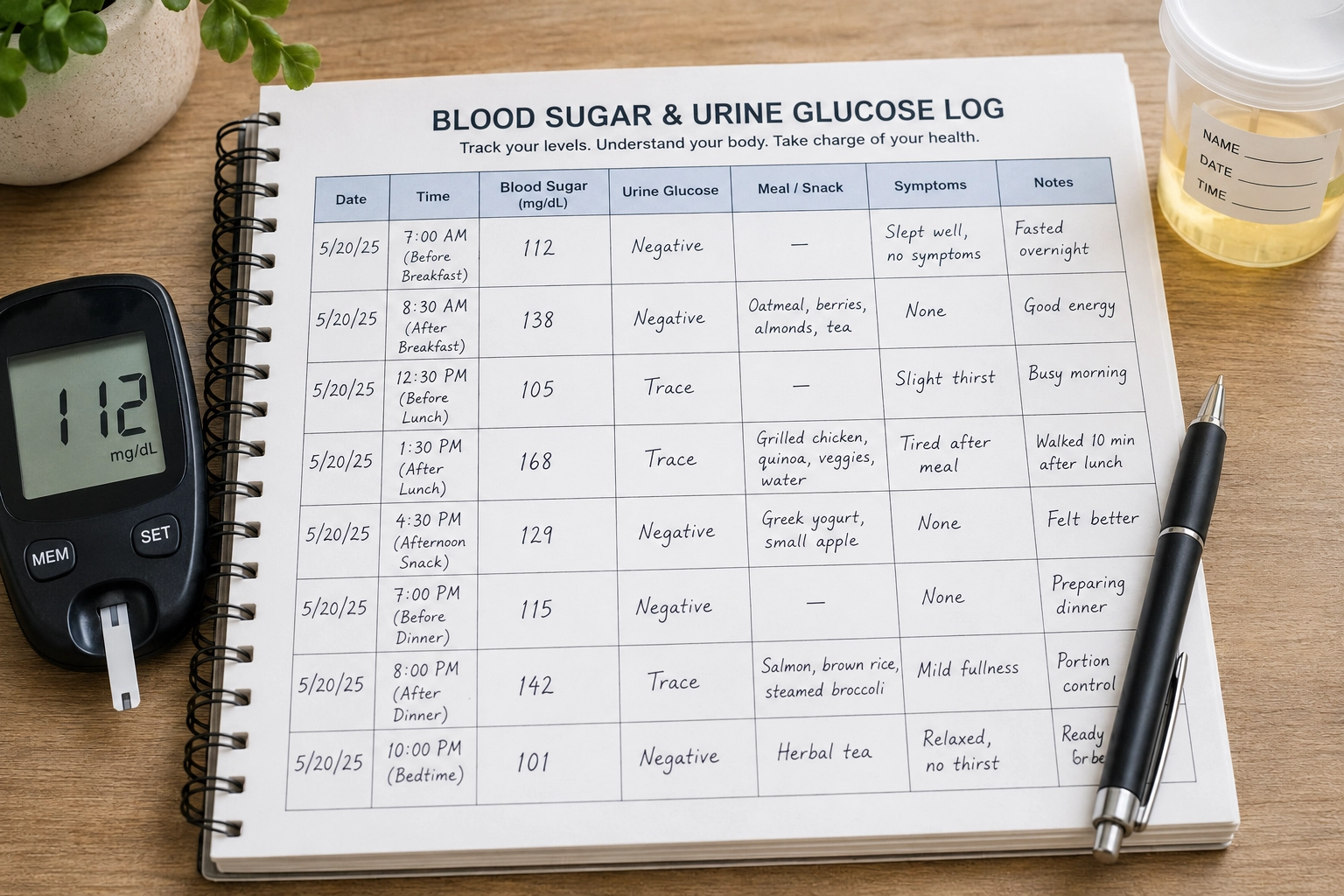
This is where a simple blood sugar log can help. Even if you are not checking blood sugar every day, writing down patterns can make a healthcare conversation clearer.
Urine Glucose vs Blood Sugar vs A1C
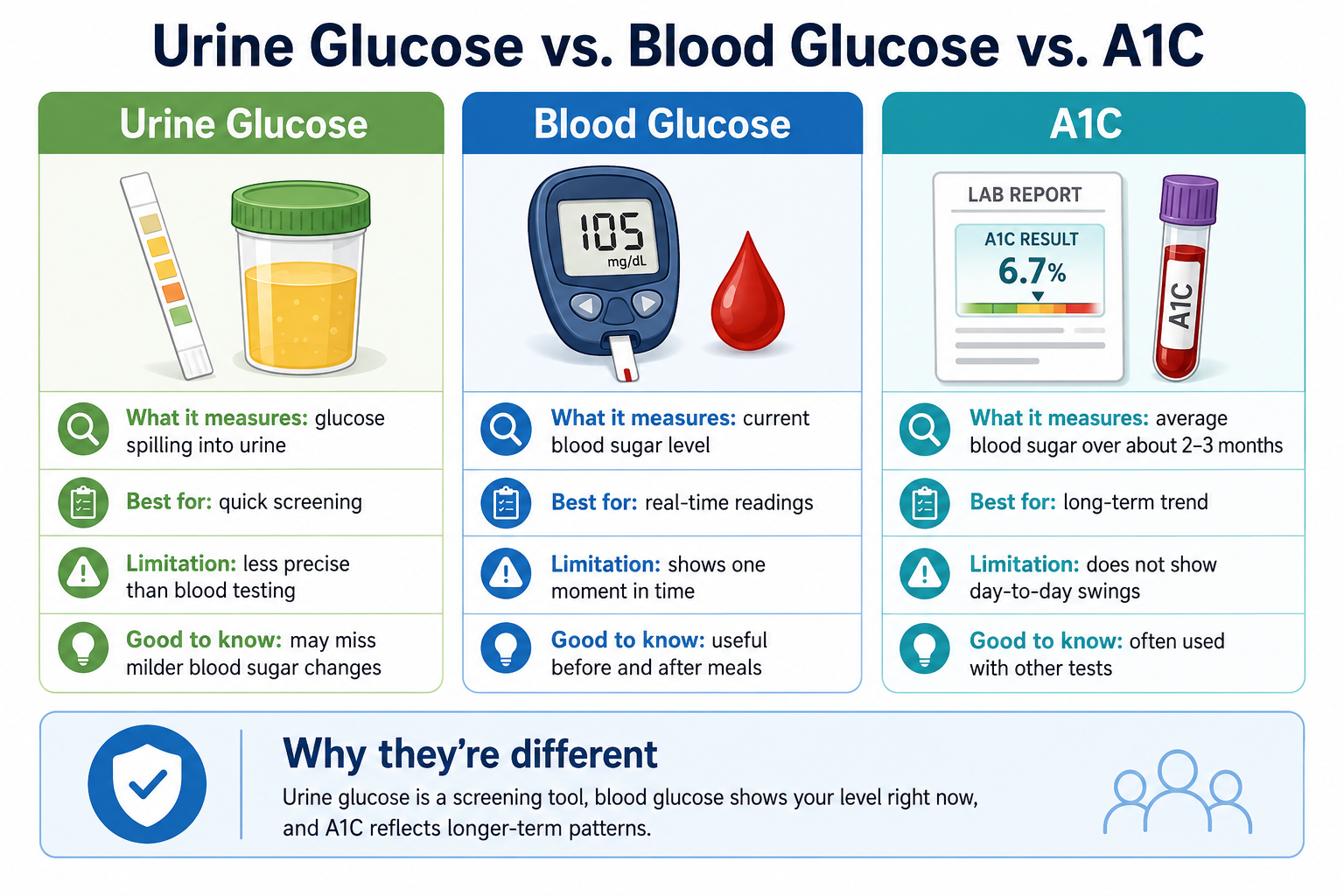
These tests answer different questions.
Test Type | What It Shows | Best Used For |
Urine glucose | Whether glucose appeared in urine | A screening clue or supplemental information |
Blood glucose | Glucose level in the blood at that moment | Day-to-day blood sugar checking |
A1C | Estimated average blood sugar over about 2–3 months | Longer-term glucose pattern |
Helps compare mg/dL and mmol/L | Understanding different blood sugar units | |
Helps estimate the relationship between average glucose and A1C | Educational comparison, not diagnosis |
A urine glucose result may raise a question. Blood glucose and A1C often help answer that question more clearly.
Common Mistakes When Using a Urine Glucose Chart
Mistake 1: Treating urine glucose as a diabetes diagnosis
Glucose in urine can be associated with diabetes, but it does not diagnose diabetes by itself. Diagnosis usually depends on blood-based testing and professional interpretation.
Mistake 2: Thinking negative urine glucose means blood sugar is perfect
A negative urine glucose result simply means glucose was not detected in that urine sample. It does not prove your blood sugar never rises higher than expected.
Mistake 3: Comparing urine glucose directly with blood glucose
Urine glucose and blood glucose are different measurements. A urine strip result like 1+ or 2+ cannot be directly converted into a blood glucose number.
Mistake 4: Ignoring repeated positive results
One result may be unclear. Repeated positive results, especially moderate or high results, should not be brushed aside.
Mistake 5: Changing medication or supplements based on a urine strip
Do not stop, start, or adjust medication based only on a urine glucose test. Also, supplements should not be treated as a way to correct glucose in urine or replace medical evaluation.
When Should You Talk With a Healthcare Professional?
Consider professional follow-up if:
- Glucose appears in urine repeatedly.
- The result is moderate or high.
- You have symptoms such as unusual thirst, frequent urination, blurry vision, fatigue, nausea, or unexplained weight changes.
- You are pregnant.
- You have known diabetes and the result is unexpected.
- You recently started or changed medication.
- You are unsure how to interpret your result.

You do not need to panic from one result, but you also do not need to guess alone.
What You Can Realistically Do Next
If you see glucose in urine, the most practical next step is not extreme dieting, panic, or searching for a quick fix.
A calmer approach is:
- Write down the result.
- Note the timing and context.
- Check whether the strip was used correctly.
- Look for repeated patterns.
- Compare with blood glucose or A1C information if available.
- Ask a healthcare professional if the result is repeated, unexpected, high, or paired with symptoms.
This gives you a clearer picture without overreacting to one test.
Practical Takeaway
A urine glucose levels chart can help you understand what “negative,” “trace,” “1+,” “2+,” “3+,” or “4+” may generally mean. But the chart is not a diagnosis.
Urine glucose is a clue. It may point toward higher blood sugar exposure, kidney-related glucose handling, pregnancy-related changes, medication effects, or testing issues. It does not show your exact current blood sugar level.
The most useful approach is to combine the result with context: whether it repeated, when it happened, whether symptoms are present, and whether blood glucose or A1C testing has been done.
If glucose in urine is repeated, unexpected, moderate to high, or connected with symptoms, discuss it with a qualified healthcare professional.
FAQ
What does glucose in urine mean?
Glucose in urine means sugar was detected in a urine sample. It may be associated with higher blood sugar, kidney-related glucose handling, pregnancy, certain medications, or testing factors. It should be interpreted with context.
What is a normal urine glucose level?
Many urine tests are expected to show negative or no detectable glucose. However, reference ranges and strip labels can vary, so it is best to compare your result with your specific lab report or test kit instructions.
Is urine glucose the same as blood glucose?
No. Blood glucose measures sugar in the blood at a specific moment. Urine glucose shows whether glucose passed into urine since the last urination. It does not provide an exact current blood sugar number.
Can urine glucose diagnose diabetes?
Urine glucose alone should not be used to diagnose diabetes. Blood-based tests such as fasting blood glucose, A1C, or an oral glucose tolerance test are usually used for diagnosis and professional interpretation.
What does trace glucose in urine mean?
Trace glucose means a small amount was detected. It may be temporary or related to timing, testing method, or other factors. If trace glucose appears repeatedly or is unexpected, it is worth discussing with a healthcare professional.
Why would glucose show in urine after eating?
After a meal, blood glucose may rise. If it rises high enough, some glucose may pass into urine. However, urine glucose does not show the exact blood sugar level at the time of testing.
Can urine glucose be positive when blood sugar seems normal?
Yes, this can happen in some situations. Timing, kidney glucose handling, hydration, medications, and test variation can all affect interpretation. Repeated or confusing results should be reviewed with a healthcare professional.
Should I worry about 1+ or 2+ glucose in urine?
A 1+ or 2+ result is worth paying attention to, especially if it repeats or comes with symptoms. It does not diagnose a condition by itself, but it may be a reason to ask about blood glucose or A1C testing.
Can pregnancy cause glucose in urine?
Glucose may appear in urine during pregnancy for different reasons, but pregnancy also changes how blood sugar is evaluated. If you are pregnant and notice glucose in urine, discuss it with your healthcare provider.
Are home urine glucose test strips accurate?
Home test strips can be useful, but they depend on proper storage, timing, reading technique, and the specific strip instructions. They should not replace professional testing or medical advice.
Health Disclaimer: This article is for general education only and is not a diagnosis or treatment plan. Urine glucose results can be affected by many factors, and they are not the same as blood glucose readings. If you have repeated glucose in urine, unexpected results, symptoms, pregnancy, or known diabetes, discuss your results with a qualified healthcare professional.
You should also read:
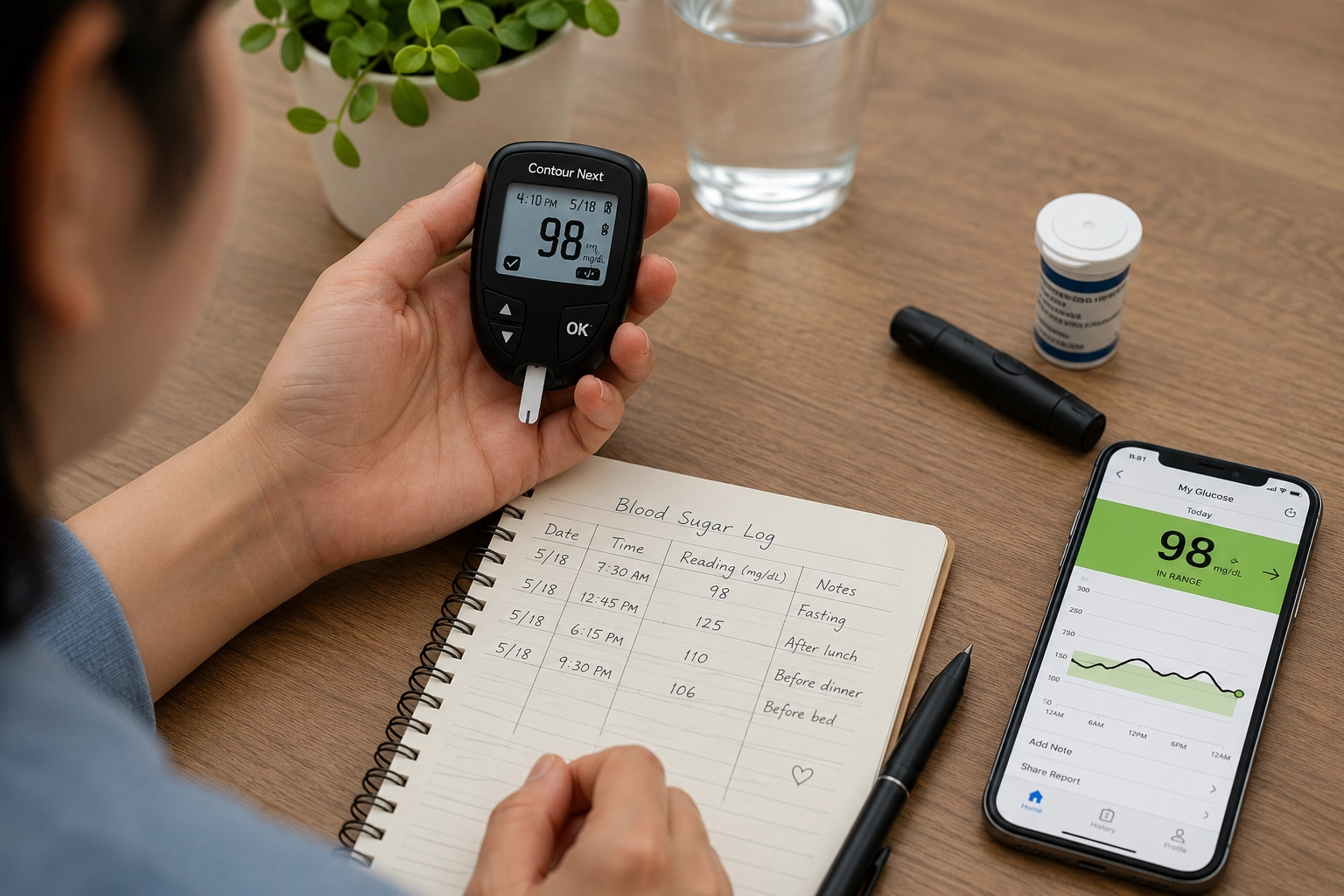
Blood Sugar Conversion Chart: How to Understand Your Glucose Numbers in Different Units
Blood sugar numbers can be confusing enough on their own. They become even more confusing when one website shows a reading in mg/dL, your glucose meter uses mmol/L, or a lab report lists a number that looks completely unfamiliar. For example, you may see 100…
Continue reading...
Blood Sugar Support in Real Life: What Actually Helps Day to Day?
If you have ever felt tired after a meal, craved something sweet in the afternoon, or felt confused by blood sugar numbers, the phrase “blood sugar support” can sound both helpful and vague. Some people use it to talk about food choices. Others use it…
Continue reading...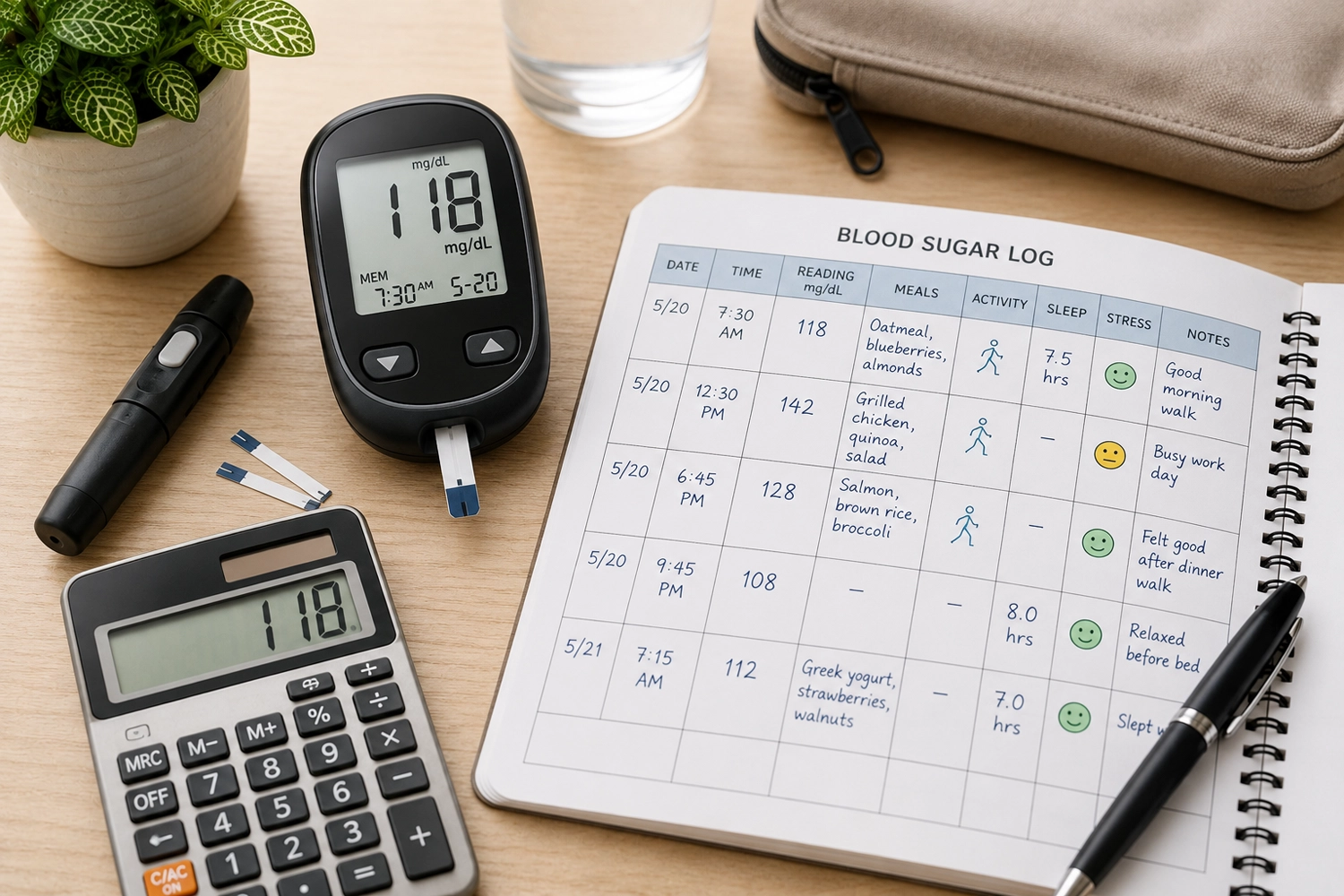
Glucose to A1C Calculator: How to Estimate A1C from Average Blood Sugar
If you track your blood sugar at home, you may already know numbers like 98, 126, 154, or 180 mg/dL. Then you go to a healthcare appointment and hear a different kind of number: your A1C. At first, it can feel like glucose readings and…
Continue reading...