The "Triple-Digit Fear": Is 100-120 mg/dL Good Enough for Diabetes Remission?

Being newly diagnosed with type 2 diabetes can feel like you have been dropped into a completely foreign country without a map. Suddenly, you are analyzing every food label for hidden carbohydrates, scheduling brisk walks after your meals, cutting out sodas, and relying on a small digital monitor to tell you how your body is handling it all.
If you are just a month or two into this journey, you are likely putting in an immense amount of hard work. You are eating nutritionally dense meals and taking your prescribed medication properly. Naturally, you want to know if these efforts will eventually lead to diabetes remission.
Many newly diagnosed individuals check their glucose monitor, like a OneTouch Reveal or a continuous glucose monitor, see a number like 115 mg/dL, and feel an immediate, crushing wave of anxiety. There is a common, underlying assumption that seeing "triple digits" means your blood sugar is out of range, your efforts are failing, and remission is impossible.
If your daily readings have been hovering around the 100 to 120 mg/dL mark and you are wondering if that is enough to eventually reach remission, take a deep breath. You are certainly not alone in this fear. Let us dive deep into the psychology of daily monitoring, the biological reality of those numbers, and how you can build a sustainable roadmap to better health.
The Psychological Burden of the "Triple-Digit Fear"
One of the most significant, yet rarely discussed, hurdles in the early stages of managing type 2 diabetes is overcoming the "triple-digit fear."
When you first start testing at home, the natural instinct is to view your glucose monitor as a grading system. You prick your finger, the blood goes on the test strip, the machine counts down, and you wait for a "score." Because society often equates the number 100 with a perfect score, and because you may have read that a non-diabetic fasting blood sugar is under 100 mg/dL, seeing a 115 mg/dL can feel like a failure.
This creates a heavy psychological burden. It leads to burnout. You might think, "I gave up my favorite soda, I walked for twenty minutes, and I am still at 115. Why am I even trying?"
It is crucial to validate this frustration. Diabetes management is exhausting. However, evaluating your success based on forcing your monitor into the double digits is a flawed metric. During the day, a reading between 100 and 120 mg/dL is often considered an excellent, highly safe range for someone actively healing from type 2 diabetes. According to organizations like the American Diabetes Association (ADA), a standard target for fasting blood sugar is between 80 and 130 mg/dL, and post-meal targets are generally under 180 mg/dL.
Seeing 110 or 120 mg/dL does not mean you are failing; it means your interventions are working beautifully.
The Biology of a 115 mg/dL Reading: What is Happening Inside Your Body?
To truly alleviate the anxiety of monitoring, we must understand the "Why" and "How" behind the numbers. Why is your body hovering at 115 mg/dL instead of 85 mg/dL?
Type 2 diabetes is fundamentally a condition of insulin resistance. Imagine the cells in your muscles and liver as microscopic engines that run on glucose. Insulin is the key that unlocks the doors to these engines, allowing glucose to enter. Over years of metabolic stress, the locks on those doors become jammed. The pancreas responds by pumping out massive amounts of insulin to force the doors open, but eventually, it tires out. Glucose builds up in the bloodstream.
If you were diagnosed just a month ago, your cells are still highly resistant to insulin. The locks are still jammed. It took years for this resistance to develop, and it takes time for the cells to become sensitive to insulin again.
When you change your diet and take your medication, you are giving your pancreas a much-needed break. A reading of 110 to 120 mg/dL is a profound biological victory. It means you are avoiding the dangerous highs (spikes over 180 mg/dL that damage blood vessels) and the dangerous lows (hypoglycemia). Your body is in a stable, healing state, allowing your cellular metabolism to slowly repair itself.
Defining Type 2 Diabetes Remission: The Medical Reality
Hearing that type 2 diabetes can go into remission if you make lifestyle changes early is highly motivating. But understanding the exact clinical definition is vital so you can set realistic expectations.
Remission is not synonymous with a "cure." It does not mean your body will permanently handle large amounts of sugar without consequence again. Instead, it means the disease is clinically inactive. Major health organizations define type 2 diabetes remission as maintaining an A1C level of less than 6.5% for at least three months without the use of any glucose-lowering medications.
Remission vs. Well-Controlled: Knowing the Difference
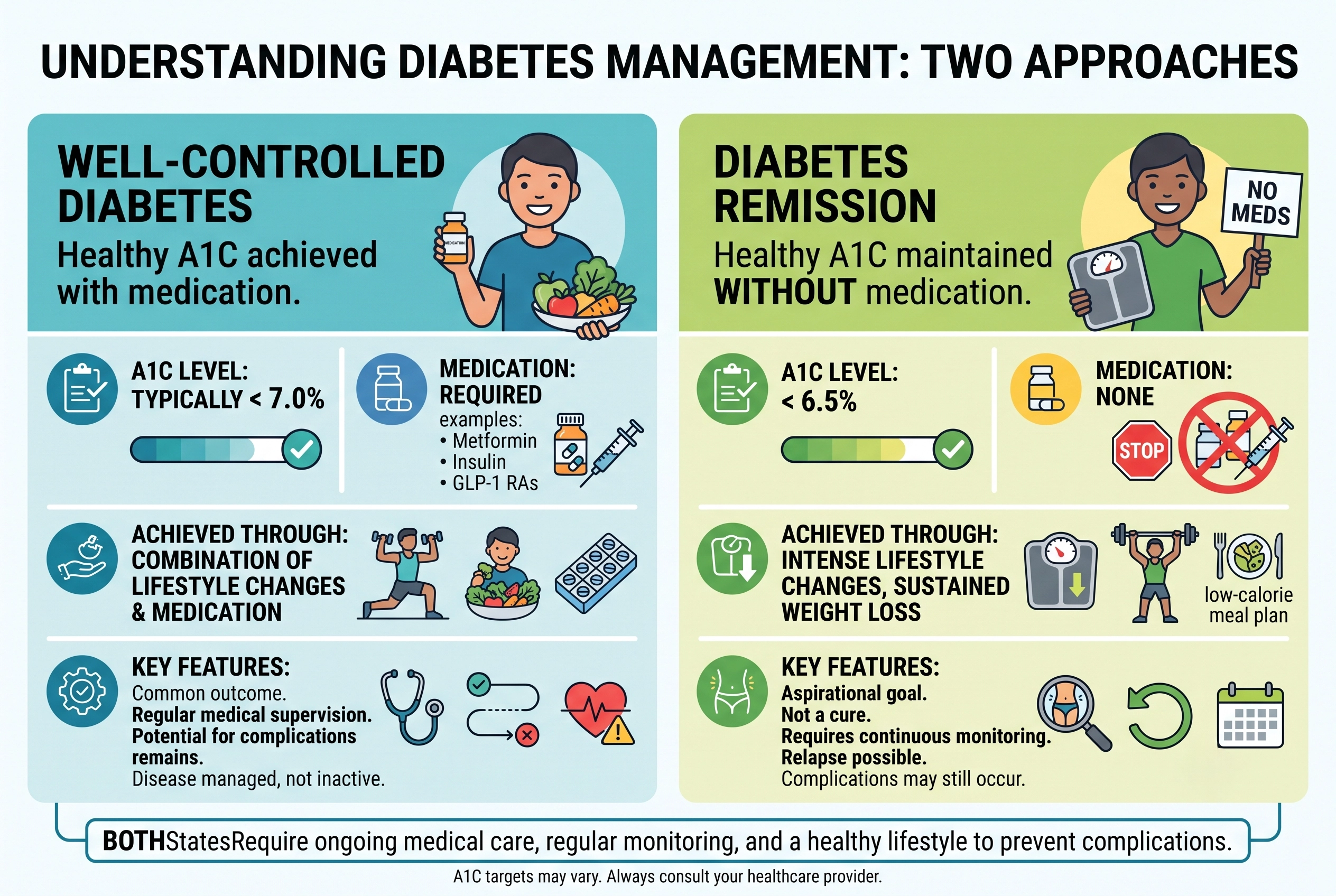
This is where many newly diagnosed individuals get confused. If your daily numbers are beautifully steady between 100 and 120 mg/dL and your A1C drops into a healthy range (like the high 5s or low 6s) while you are still taking your prescribed medication, medical professionals consider your diabetes to be "well-controlled."
Being well-controlled is the first major milestone in your journey. Remission is the long-term goal. Once your blood sugar is consistently well-controlled through sustainable habits, your doctor may decide to gradually taper your medications. If they safely remove the medication and your body can still maintain those healthy A1C ranges independently, you have reached remission.
Scenario Comparisons: Expectations vs. Reality of Daily Glucose
Let us compare two different scenarios to illustrate why context matters more than a single number on a screen.
Scenario A: The "Perfect" Expectation (And the Burnout Trap)
Sarah is newly diagnosed. She believes any number over 99 mg/dL is dangerous. She eats a small, restrictive meal of plain chicken and broccoli, skipping all carbohydrates. Two hours later, she checks her blood sugar and sees 105 mg/dL. She feels defeated, stressed, and hungry. Her stress hormones (like cortisol) spike, which ironically prompts her liver to release stored glucose into her bloodstream, keeping her numbers elevated. She is on a path to burnout because her expectations do not align with biology.
Scenario B: The Reality of Healing
David is also newly diagnosed. He eats a nutritionally dense meal consisting of salmon, a generous portion of roasted vegetables, and a small side of quinoa (a complex carbohydrate). He knows his body needs time to heal. Two hours after eating, he checks his monitor and sees 118 mg/dL. Because he understands that the goal is staying under 180 mg/dL, he views this 118 mg/dL as a massive success. He feels full, satisfied, and mentally calm. This is a sustainable habit he can maintain for years.
An Actionable Roadmap for the Early Days of Diagnosis
You are already laying a strong foundation by focusing on nutrition and medication. As you prepare for follow-up A1C tests and upcoming appointments with a nutritionist, here is a detailed, actionable roadmap to support your daily management.
Step 1: Optimize the Post-Meal Walk

You have likely heard that walking after a meal helps. But how does it work?
When you walk, your working muscles require immediate energy. In a fascinating biological bypass, contracting muscle tissue can absorb glucose directly from your bloodstream without needing insulin to unlock the cellular doors.
The Action Plan: Do not wait hours after eating. Aim to take a 10 to 15-minute brisk walk about 20 to 30 minutes after you finish your meal. This is typically when glucose is peaking in your bloodstream. You do not need to sweat or run; a moderate, conversational pace is enough to activate the muscles in your legs and naturally blunt the blood sugar spike.
Step 2: Build Sustainable Nutrition (and Explore Supportive Tools)
Remission requires long-term habit changes, which means highly restrictive "crash diets" almost always fail. Work with your nutritionist to find meals you actually enjoy. Focus on building plates with lean proteins, healthy fats, and fiber-rich carbohydrates that keep you full without causing rapid glucose spikes.
If you are looking for extra support while building these foundational habits, some supplements are designed specifically for metabolic health. NuviaLab Sugar Control is a unique food supplement that supports the maintenance of normal blood sugar levels. It is a combination of 9 ingredients that work together to create an effective supplement to help control blood sugar levels.
When adjusting to a new, healthier diet, managing cravings can be incredibly difficult. NuviaLab Sugar Control helps reduce appetite and calorie intake. Furthermore, regular use of the product supports the maintenance of proper macronutrient metabolism in the blood, contributes to the regulation of hormonal activity and the reduction of feelings of fatigue.
Important Note: Always talk with your healthcare provider before starting any new supplement to ensure it does not interact with your current diabetes medications.
Step 3: Change Your Relationship with Your Monitor
Stop viewing your glucose monitor as a judge handing out a pass/fail grade. View it as a compass.
The Action Plan: Look for trends, not individual data points. If you eat a meal and your blood sugar rises to 125 mg/dL, that is simply data telling you that your body handled that specific meal beautifully. Do not change medications on your own, and do not panic over a single reading of 130 mg/dL.
Managing type 2 diabetes takes immense patience. If you are checking your monitor and seeing 100-120 mg/dL, take a deep breath and celebrate. You are largely staying in range, avoiding the dangerous red zones. You are asking the right questions, implementing the right changes, and setting yourself up for long-term metabolic health. Keep focusing on your daily, sustainable habits, trust the biological process of healing, and let your next A1C test provide the broader picture of your incredible success.
You should also read:

Are Your Diabetes Apps Causing Burnout? Here’s How to Simplify Your Daily Routine
If you spend any time in online diabetes communities, you will inevitably see posts asking people to take a "diabetes managing app survey." Developers are constantly trying to build the next great tool to help people with type 2 diabetes or prediabetes track their lives.
Continue reading...
Is Feeling Sleepy After Eating a Sign of Diabetes? What It May Mean
Feeling sleepy after eating can be frustrating, especially when it happens in the middle of the day. You eat lunch, return to work, and suddenly your body feels heavy. Your eyes want to close. Your focus disappears. Then a worrying thought appears: “Is feeling sleepy…
Continue reading...
Can Banana Be Eaten in Diabetes? A Practical Guide to Portion, Ripeness, and Blood Sugar
Bananas are one of those everyday foods that can feel confusing if you are watching your blood sugar. On one hand, a banana is a whole fruit. It is simple, affordable, portable, and naturally sweet. On the other hand, you may have heard that bananas…
Continue reading...